
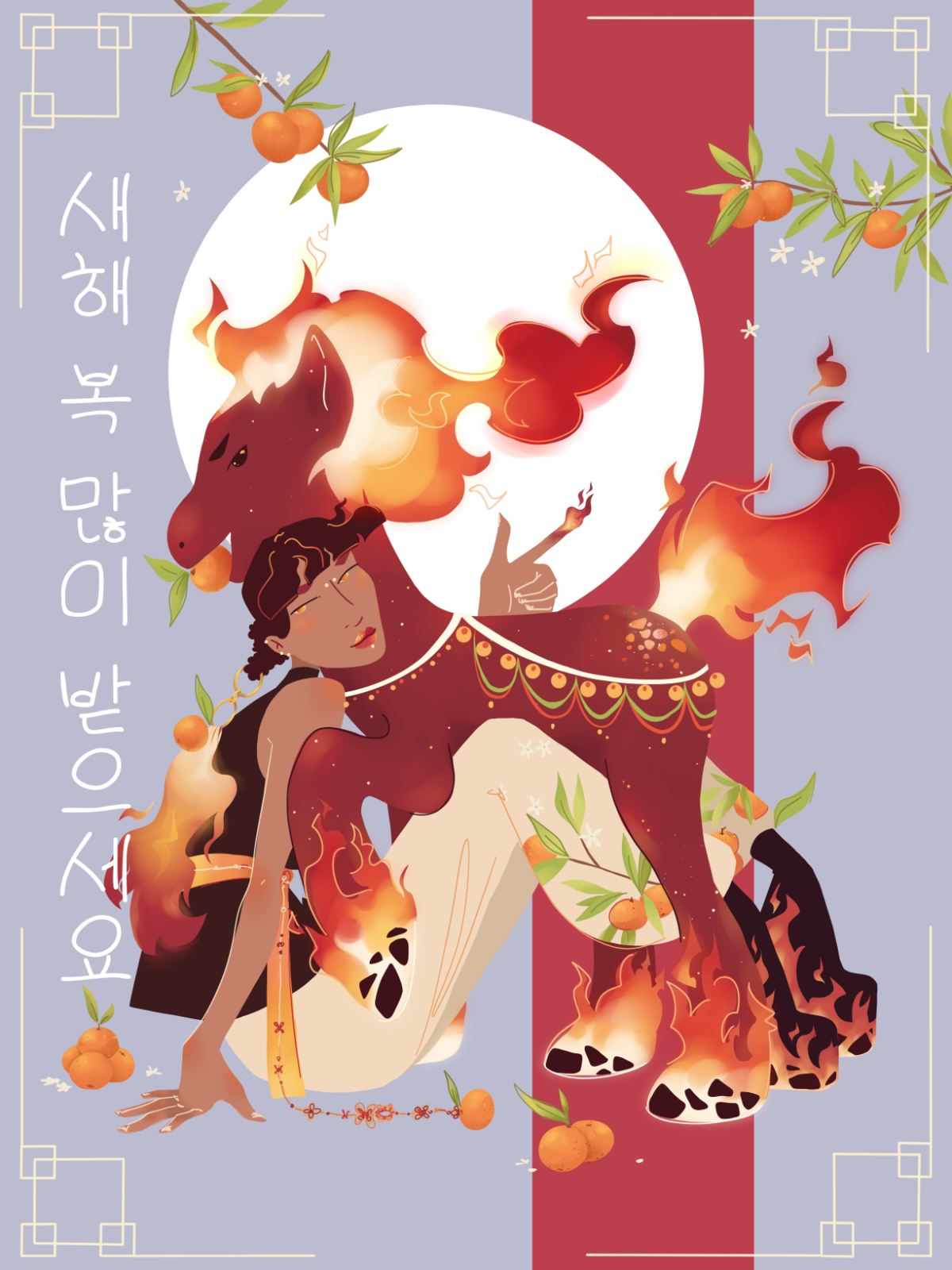
“And here we are — a new sign added to the collection!
Ah… horses… what wonderfully complicated creatures — I was a bit intimidated by them! But I’m absolutely happy with my pony, and I hope you’ll accept him just the way he is, as much as he feels ‘on fire’!”
by Tomasz Sleziak
The Lunar New Year is rapidly approaching – this year it will be on the 17 February. In the wider region of East Asia, it is always a celebrated occasion, and in countries directly influenced by Chinese culture, such as Korea, it is especially so.
The year of the Fire Horse
The year of the Fire Horse (Kor. 병오 丙午, Byeongo) is the 43rd year in the sexagenary cycle of 60 years, and the entire system is based on two factors – the 10 Heavenly Stems and 12 Earthly Branches, the former of which refers to the male-female (yang-yin) variants of 5 traditional “elements” (water, fire, wood, metal and earth), and the latter of which refers to the 12 Chinese “zodiac animals”.
Each of these heavenly stems combines with earthly branches 60 times, and after 60 years (a significant, symbolic age all over East Asia) the cycle begins anew – it always starts with the Year of the Yang Wood Rat (Kapja 갑자 in Korean), and ends with the Year of the Yin Water Pig (Gyehae 계해).
Each year begins with the new moon, and the new year is marked by the second new moon after the lunar month that has Winter Solstice in it (so typically you count two new moons after 21 December or so).
The sexagenary cycle used to be the main system of counting years in ancient China and Korea, but nowadays its symbolism mainly remains in vogue as part of divination system – the so-called “Four Pillars of Destiny” – and popular entertainment.
There are websites (such as https://www.wofs.com/four-pillar-calculator/) that allow you to let you calculate your four pillars, though it is admittedly a highly complex system and in most cases the results are displayed in Chinese characters – the system used in Korea is the same, however.